Fitness in a Minute – Cranky Knees
August 13, 2020
What are the best exercises for lower body strengthening for those who have knee pain? Susan Gilmore, shows us 3 exercises for the lower body that won’t aggravate your knees.



What are the best exercises for lower body strengthening for those who have knee pain? Susan Gilmore, shows us 3 exercises for the lower body that won’t aggravate your knees.
Our Navigators are here for you. Life with Cancer Oncology Nurse Navigators can help individuals learn about their disease, treatment plans, side effects, procedures, clinical trials…and more.
Article was written by the Life with Cancer team in the latest issue of Cure Magazine.
Life with Cancer Registered Dietician, Lauren Fay, provides some guidelines on how to achieve and maintain a healthy body weight.
Improve how you care for yourself during times of crisis by creating a personalized self-care plan. We’ll walk you through the completion of this plan with a fillable worksheet that accompanies a 15-minute video/audio.
by Kaitlyn O’Donnell, MSW, LCSW, Life with Cancer Oncology Clinical Therapist
Download PDF Example Download Fillable WorksheetFor the rising number of cancer survivors worldwide, there’s growing evidence that exercise is an important part of recovery. But how much, and what type of exercise, is needed?
A recent review of research, conducted by an international group of experts led by the University of British Columbia, has resulted in the development of new exercise guidelines for cancer survivors.
The updated recommendations, published today in Medicine & Science in Sports & Exercise, outline specific ‘exercise prescriptions’ to address common side effects, such as anxiety and fatigue, associated with cancer diagnoses and treatment.
In general, the new guidelines recommend survivors perform aerobic and resistance training for approximately 30 minutes per session, three times a week. This is a departure from earlier guidelines, published nearly a decade ago, which advised cancer survivors to meet the general public health guidelines for all Americans — 150 minutes of exercise a week.
“Exercise has been regarded as a safe and helpful way for cancer survivors to lessen the impact of cancer treatment on their physical and mental health, but the precise type and amount of exercise to treat the many different health outcomes related to cancer treatment hasn’t been clear,” says the paper’s lead author, Dr. Kristin Campbell, associate professor at UBC’s department of physical therapy. “In the absence of this information, cancer survivors were advised to strive toward meeting the general public health guidelines for all Americans — an amount of physical activity that may be difficult for people to achieve during or following cancer treatment.”
The new recommendations are based on a substantive review and analysis of the growing body of scientific evidence in the field. Since the first guidelines were put forward in 2010, there have been more than 2,500 published randomized controlled exercise trials in cancer survivors — an increase of 281 percent.
The new paper is just one of three papers published today that summarizes the outcomes of an international roundtable that explored the role of exercise in cancer prevention and control. The roundtable brought together a group of 40 international, multidisciplinary experts from various organizations who conducted a thorough and updated review of the evidence on the positive effects of exercise in preventing, managing and recovering from cancer.
Together, the three papers offer new evidence-backed recommendations for incorporating exercise into prevention and treatment plans and introduce a new Moving Through Cancer initiative, led by the American College of Sports Medicine, to help clinicians worldwide implement these recommendations.
The new recommendations include:
Story Source:
Materials provided by University of British Columbia. Note: Content may be edited for style and length.
Journal Reference:
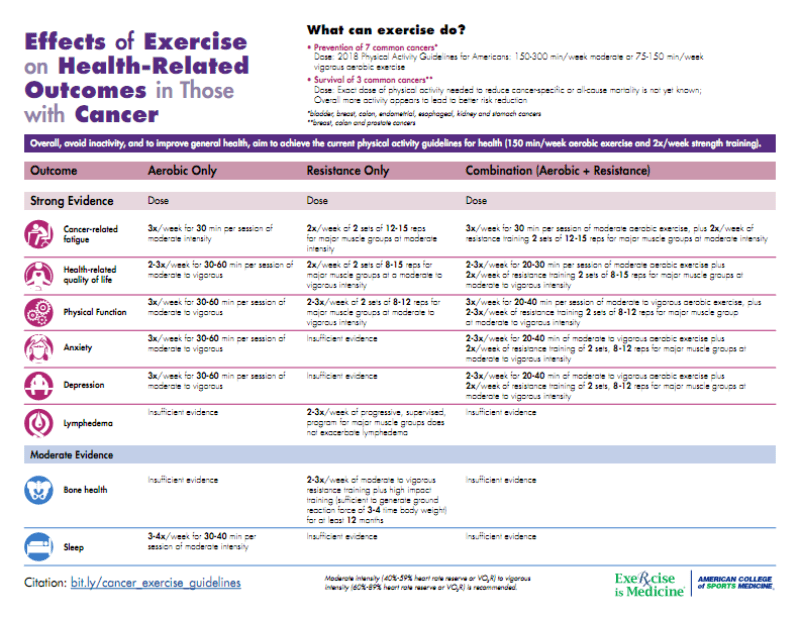
In October 2019, three papers were published following an International Multidisciplinary Roundtable hosted by ACSM. One of those papers, a consensus statement, listed specific exercise recommendations for cancer patients and survivors.
This infographic outlines the effects of exercise on health-related outcomes in those with cancer. The chart features evidence-based physical activity recommendations and the associated benefits for specific symptoms and side effects of cancer and its treatments.
To download the infographic
Reprinted from Cancer Care
Cancer and its treatment can be stressful for people with cancer and their caregivers. Relaxation techniques and other mind/body practices can help calm your mind and sharpen your ability to focus. These techniques offer creative ways to reduce stress caused by cancer and to maintain inner peace. For example, some people use these techniques to help them relax as they wait for treatments or test results.
Here are some techniques that can help you cope with the challenges of cancer:
At the core of life is breath. Laughing and sighing are the body’s natural ways of getting us to breathe deeply.
That is why we often feel calmer or rejuvenated after these experiences. Anxiety and stress can make us take short, shallow breaths. Shallow breathing, which does not allow enough oxygen to enter our bodies, can make us even more anxious. Try this four-step breathing exercise.
It can be done anywhere, anytime:
1. Take in a deep breath from your diaphragm (this is the muscle between your lungs and abdomen).
2. Hold the breath for several seconds—however long is comfortable for you—and then exhale slowly.
3. Repeat steps 1 and 2 two more times.
4. Afterward, relax for a moment and let yourself feel the experience of being calm
Repetitive prayers are a form of meditation. Two other traditional forms of meditation include one-pointed and two-pointed meditation.
One-pointed meditation focuses on a word or sound called a mantra. Many people create their own mantra from an affirming word, such as “peace,” “love” or “hope.” Once you choose a mantra, find a safe, quiet place and repeat it to yourself during 15- to 20-minute sittings. The goal is to relax the mind, which has a natural tendency to jump from one idea to the next—and from one worry to the next. Do not try to force your mind back to your mantra when you notice it has wandered. Simply guide it back gently, accepting that it may stray again.
Two-pointed meditation is also called mindful or insight meditation. With this technique, you relax your mind by focusing on your breath. As your mind jumps around, practice non-judgmental awareness—simply observe the pattern of your thoughts and gently guide them back to focus on your breath. Non-judgmental awareness allows you to separate yourself from emotions and sensations rather than getting pulled into them. One benefit of this type of meditation is that you can practice it while seated quietly or when doing daily activities.
This stress-reducing technique combines deep breathing and meditation. As you practice deep breathing, imagine a peaceful scene or setting, perhaps from a memory. Once you are relaxed, you can create a “wakeful dream” in which, for example, you envision pain being washed away or your body becoming stronger.
Many people practice guided imagery exercises while listening to recordings of ambient sounds. These are usually music or sounds from nature, such as waterfalls or ocean waves. Sometimes just listening to ambient sounds is enough to relax your mind and briefly transport you emotionally to a place in which you feel safer and more secure. Other mind/body practices are yoga, tai chi, and Qigong. These techniques are often taught at health clubs, YMCA’s and senior centers around the country.
Many cancer treatment centers have programs to teach people with cancer and caregivers the basics of relaxation or meditation.
There are a number of easy-to-follow educational books, websites and audio-recordings on this subject that provide step-by-step instructions. Your nurse or oncology social worker may also be familiar with relaxation exercises and mind/body practices, or he or she may be able to refer you to others who can help you learn these techniques.
Feed your breakfast inspiration with this week’s special recipe feature: 6 healthy breakfast toasts. All of these toasts pack a hearty dose of fiber and protein, and many also include heart-healthy fats. Today’s featured toast is the perfect combination of savory and sweet flavors. It’s light and refreshing and works well with any type of berry in season. Berries are particularly high in ellagic acid, a phytochemical that has been shown to have strong cancer-protective properties.

Ingredients:
Makes 1 serving.
Per Serving: 140 calories, 4 g total fat (1.5 g saturated fat), 23 g carbohydrate, 3 g dietary fiber, 5 g protein, 135 mg sodium.
March 13, 2018 issue of AICR.ORG
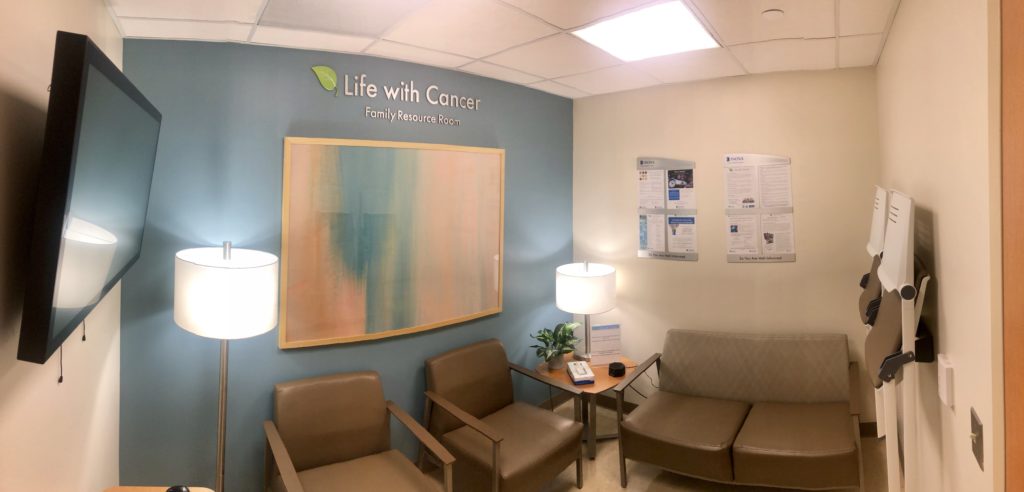
Exciting news to share! The Life with Cancer location at the Inova Fairfax Medical Campus has recently opened a newly renovated Family Resource Room in South Tower 9. The new and improved Life with Cancer Family Resource Room offers a safe, warm, and welcoming space for counseling visits, meditation, relaxation, care team discussions, and educational classes. Be sure to stop by to check it out!
Find support through programs

Get in touch with one of our team members.


 Back To Top